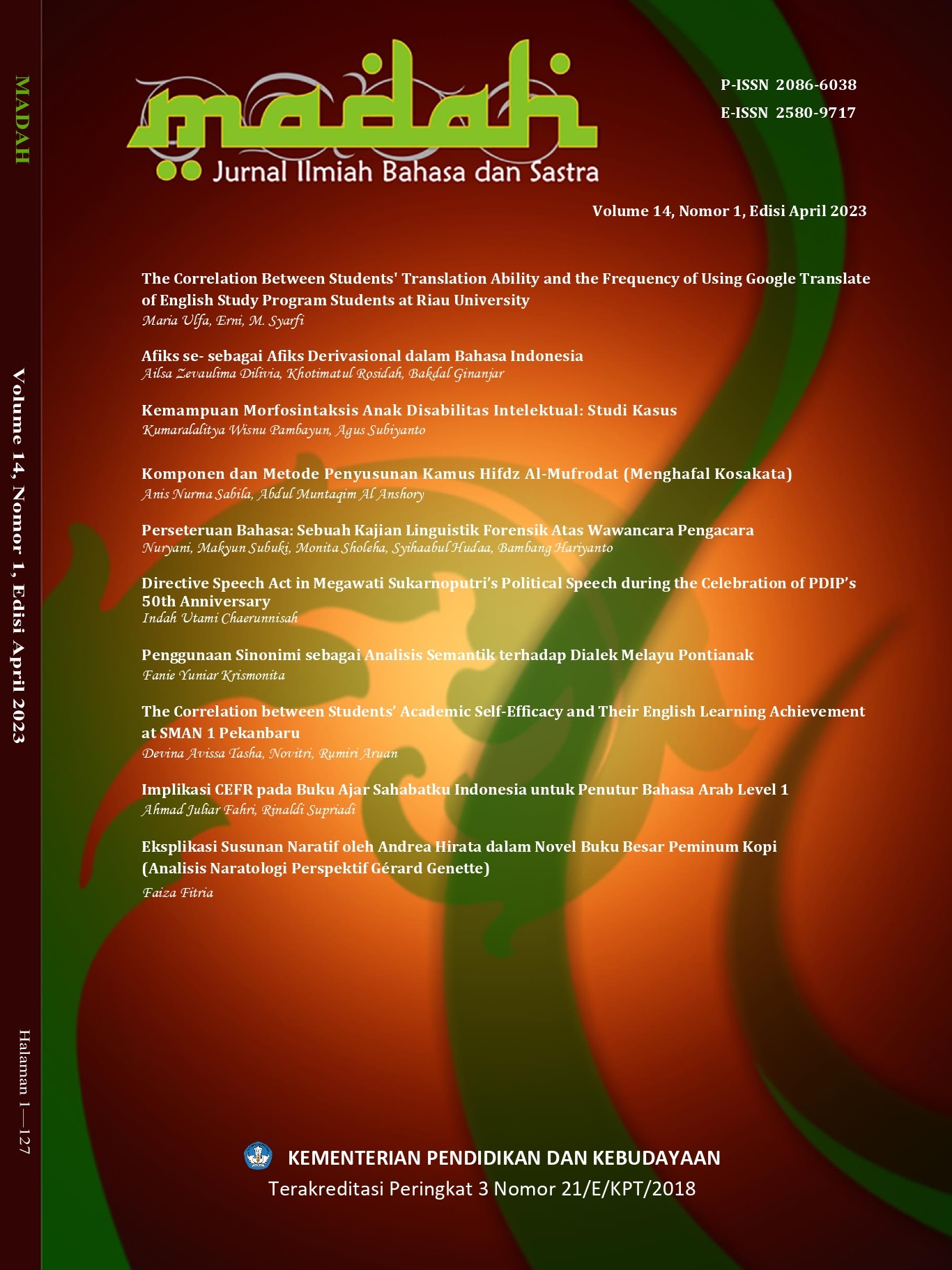
The Correlation between Students’ Academic Self-Efficacy and Their English Learning Achievement at SMAN 1 Pekanbaru
DOI:
https://doi.org/10.31503/madah.v14i1.551Kata Kunci:
Correlation, Academic Self-Efficacy, English, Learning AchievementAbstrak
Kajian ini bertujuan untuk membuktikan apakah ada korelasi yang signifikan antara efikasi diri pada akademik siswa dan capaian pembelajaran Bahasa Inggris di SMAN 1 Pekanbaru. Berhubungan dengan desain penelitian korelasional, studi ini menggunakan pendekatan kuantitatif. Jumlah populasi penelitian adalah 250 siswa dari kelas sepuluh di SMAN 1 Pekanbaru, sedangkan sampelnya adalah 70 siswa yang dipilih menggunakan teknik Cluster Random Sampling. Instrumen yang digunakan adalah kuesioner untuk mengukur efikasi diri pada akademik siswa dan data sekunder yang diambil dari hasil ujian akhir Bahasa Inggris. Untuk menganalisis data, peneliti menggunakan SPSS 25. Hasil menunjukkan bahwa korelasi koefisien antara dua variabel adalah 0.422 dan dikategorikan sebagai ‘moderat’. Sedangkan untuk determinan koefisien efikasi diri pada akademik siswa adalah 0.1780. Maka dapat disimpulkan bahwa ada korelasi signifikan yang moderat dan positif antara dua variabel.Referensi
Ahmad, A., & Safaria, T. (2013). Effects of self-efficacy on students’ academic performance. Journal of Educational, Health, and Community, 2(1), 22–29.
Akram, B., & Ghazanfar, L. (2014). Self-efficacy and academic achievement performance of the students of Gujrat University, Pakistan. Academic Research International, 5(1), 283–290.
Al-Abyadh, M. H. A., & Azeem, A. H. A. H. (2022). Academic achievement: influences of university students’ self-management and perceived self-efficacy. Journal of Intelligence, 10(3), 55.
Azwar, S. (2012). Metode Penelitian. Yogyakarta: Pustaka Pelajar.
Bai, B., Chao, G., & McInerney, D. M. (2018). Self-efficacy and self-concept as predictors of language learning achievements in an Asian bilingual context. The Asia Pacific Education Researcher, 28(2), 139–147.
Bandura, A., Adams, N. E., & Beyer, J. (1977). Cognitive processes mediating behavioral change. Journal of Personality and Social Psychology, 35, 125-139.
Bandura, A. (1986). Fearful expectations and avoidant actions as coeffects of perceived self-inefficacy. American Psychologist, 41(12), 1389–1391. https://doi.org/10.1037/0003-066X.41.12.1389
Bandura, A. (2013). Regulative function of perceived self-efficacy. In Personnel Selection and Classification (pp. 279–290). Psychology Press.
Bloom, B. S. (1956). Taxonomy of Educational Objectives, Handbook I: The Cognitive Domain. New York, NY: McKay
Cheng, Y. Y. (2020). Academic self-efficacy and assessment. Educational Psychology, 40(4), 389–391.
Creswell, J. W. (2012). Educational Research: Planning, Conducting, and Evaluating Quantitative and Qualitative Research. Upper Saddle River, NJ: Merrill
Enny, W. E., & Pujara, L. (2017). Influence of self-efficacy on academic achievement of school children. International Journal of Research in Applie, Natural and Social Sciences. 5(8), 2321–8851.
Gafoor, K. A. & Ashraf, P. M (2012). Contextual influences on sources of academic self-efficacy: A validation with secondary school students of Kerala. Asia Pacific Education Review, 13, 607–616.
Güngör, A. Y. (2020). The relationship between academic procrastination academic self-efficacy and academic achievement among undergraduates. Oltu Beşeri ve Sosyal Bilimler Fakültesi Dergisi, 1(1), 57–68.
Hassan, A. E. (2015). Influence of self-efficacy as predictors of academic achievement. International Journal of Education and Research, 3(3), 275–284.
Honicke, T., & Broadbent, J. (2016). The relation of academic self-efficacy to university student academic performance: A systematic review. Educational Research Review, 17, 63–84.
Hoque, S. S. I., Chowdhury, A. A., Hossen, M. R., & Arjumand, D. (2021). Can tailoring skills be delivered through e-learning platform; perspective of the three-learning domains (cognitive, affective and psychomotor domain). American International Journal of Education and Linguistics Research, 4(1), 31–38.
Graham, S., Woore, R., Porter, A., Courtney, L., & Savory, C. (2020). Navigating the challenges of L2 reading: Selfâ€efficacy, selfâ€regulatory reading strategies, and learner profiles. The Modern Language Journal, 104(4), 693–714.
Kitikanan, P., & Sasimonton, P. (2017). The relationship between English self-efficacy and English learning achievement of L2 Thai learners. LEARN Journal: Language Education and Acquisition Research Network, 10(1), 149–164.
Kolo, A. G., et al. (2017). Relationship between academic self-efficacy believed of college students and academic performance. IOSR Journal of Humanities and Social Science, 22(1), 75–80.
Lei, H., Cui, Y., & Zhou, W. (2018). Relationships between student engagement and academic achievement: A meta-analysis. Social Behavior and Personality: An International Journal, 46(3), 517–528.
Maladerita, W., Septiana, V. W., Gistituati, N., & Betri, A. (2021). Peran guru dalam menerapkan Kurikulum 2013 di sekolah dasar. Edukatif: Jurnal Ilmu Pendidikan, 3(6), 4771–4776.
Meral, M, et al. (2012). The relationship between self-efficacy and academic performance. Proceedia Social and Behavioral Sciences, 21(1), 151–154.
Morán-Soto, G., & Benson, L. (2018). Relationship of Mathematics Self-Efficacy and Competence with Behaviors and Attitudes of Engineering Students with Poor Mathematics. International Journal of Education in Mathematics, Science and Technology, 6(3), 200–220.
Mustika, U. D. (2022). Pengaruh dukungan ibu terhadap prestasi belajar anak yang dimediasi oleh peregulasian-diri dalam belajar. PSIKOVIDYA, 26(1), 16–26.
Riduwan. (2011). Skala Perhitungan Variabel-Variabel Penelitian. Bandung: Alfabeta
Rovers, S. F., Clarebout, G., Savelberg, H. H., de Bruin, A. B., & van Merriënboer, J. J. (2019). Granularity matters: comparing different ways of measuring self-regulated learning. Metacognition and Learning, 14, 1–19.
Schunk, D. H. & Maria K. D. (2020). Self-Efficacy and Human Motivation. Advances in Motivation Science, 1(1). 1–27.
Shin, M. H. (2018). Effects of project-based learning on students' motivation and self-efficacy. English Teaching, 73(1), 95–114.
Shkullaku, R. (2013). The relationship between self-efficacy and academic performance in the context of gender among Albanian students. European Academic Research, 1(4), 467–478.
Slameto. (2013). Belajar dan Faktor-faktor yang Mempengaruhinya. Jakarta: Rineka Cipta.
Sugiyono. (2014). Metode Penelitian Pendidikan Pendekatan Kuantitatif, Kualitatif, dan R&D. Bandung: Alfabeta.
Sugiyono. (2017). Metode Penelitian Bisnis Pendekatan Kuantitatif, Kualitatif, Kombinasi, dan R&D (3rd ed.). Bandung: ALVABETA, CV.
Thompson, G., Aizawa, I., Curle, S., & Rose, H. (2022). Exploring the role of self-efficacy beliefs and learner success in English medium instruction. International Journal of Bilingual Education and Bilingualism, 25(1), 196–209.
Usher, E. L., & Schunk, D. H. (2018). Social cognitive theoretical perspective of self-regulation. In D. H. Schunk & J. A. Greene (Eds.), Handbook of self-regulation of learning and performance (pp. 19–35). Routledge/Taylor & Francis Group. https://doi.org/10.4324/9781315697048-2
Wang, C., & Bai, B. (2017). Validating the instruments to measure ESL/EFL learners' self-efficacy beliefs and self-regulated learning strategies. TESOL quarterly, 51(4), 931–947.
Wigfield, A., Tonks, S. M., & Klauda, S. A. (2016) Handbook of Motivation at School.Routledge.
Yantraprakorn, P., Darasawang, P., & Wiriyakarun, P. (2018). Self-efficacy and online language learning: Causes of failure. Journal of Language Teaching and Research, 9(6), 1319–1329.
Yokoyama, S. (2019). Academic self-efficacy and academic performance in online learning: A mini review. Frontiers in Psychology, 9, 2794.
Zhu, Z. Y., Jiang, M. D., Xu, P. P., Chen, W., Ni, Q. Q., Lu, G. M., & Zhang, L. J. (2020). Coronavirus Disease 2019 (COVID-19): A Perspective from China.
Zimmerman, B. J. (1995). Self-efficacy and educational development. Self-efficacy in Changing Societies, 1(1), 202–231.
##submission.downloads##
Diterbitkan
Cara Mengutip
Terbitan
Bagian
Lisensi
Hak Cipta (c) 2023 Devina Avissa Tasha

Artikel ini berlisensiCreative Commons Attribution-NonCommercial-ShareAlike 4.0 International License.
The author who published an article in the Madah journal has agreed on the following points.
- Author retain copyright and grant the journal of first publication with the work simultaneously licenced under Creative Commons Atribution Licence (CC BY-NC-SA 4.0) that allows other to share the work with an acknowledgement of the work's authorship and initial publication in this journal.
- Authors are allowed to publish articles that have been published by the Journal of Madah through separate contractual agreements for non-exclusive dissemination (e.g, placing them into an institutional repository or publishing them in a book) by keeping the first issue in the Madah journal.
- Authors are permitted and encouraged to disseminate their work in cyberspace (e.g, in institutional repositories or author pages) before and during the submission of the text document as it can support productive exchange of earlier and broader credits.